Choosing a reliable VPS hosting provider can feel like a tough decision. Every host promises speed, uptime and support, and after a while all the spec sheets start to look the same. Yet the server you pick is a long-term commitment — just as we all want a trustworthy and reliable friend when moving into a new apartment, you want a VPS you can depend on for years, not weeks. This is especially true in Malaysia, where the physical location of your server and the quality of local support make a real difference to day-to-day performance.
This guide explains what a Virtual Private Server actually is, what people use one for, and the eight factors — from RAM and CPU to server location and price — that separate the best VPS hosting from a cheap disappointment.
What Is a Virtual Private Server (VPS)?
A Virtual Private Server (VPS) is a virtual machine that runs its own operating system — typically Linux or Windows — on a physical server it shares with other users, while its RAM, CPU and storage are reserved for you alone. Unlike a dedicated server, where one customer occupies the whole machine, virtualization technology divides the physical server into multiple isolated compartments. Although these compartments share the same hardware, the resources are allocated individually and separately for each one, so a noisy neighbour cannot eat into your share. That isolation is what makes a VPS behave like a small dedicated server at a fraction of the price.
What Are the Uses and Benefits of a VPS?
A VPS is most commonly used to host websites, run game servers, and keep Forex Expert Advisors (EAs) trading around the clock — including running multiple MT4 accounts from a single server. Anything that needs to stay online 24/7 without depending on your home computer is a natural fit.
Running these workloads on a personal computer takes up a lot of computing resources and electricity, especially when the task requires an uninterrupted internet connection day and night. A home network cannot promise that, nor can it guarantee a smooth, stable connection. A reliable VPS hosting plan gives you:
- A great amount of saving on electricity consumption
- Uninterrupted internet connection 24/7
- Stable and reliable internet connection 24/7
- 99.9% uptime
- Secured data
- Ease of scalability
- Quick and easy problem-solving with 24/7 customer support
These points matter most if you are a Forex trader, whose profits and losses depend entirely on how smoothly and quickly your orders reach the trading platform.
8 Factors to Consider Before Buying a VPS
Before you buy, compare providers on eight factors: RAM, CPU performance, storage type and size, bandwidth, guaranteed uptime, ease of upgrades, where the server is physically located, and the quality of customer support. Here is what each one means and what to look for.
1. RAM
Random Access Memory (RAM) is the fast working memory of your server: it holds the data your applications are actively using, so more RAM means more can happen at once before the server slows down. VPS hosting plans typically start at 1 GB of RAM and go up to 8 GB, depending on your needs.
A small website or a single lightweight application runs comfortably at the entry level, while busy stores and heavier workloads benefit from 2–8 GB. Low-latency memory matters most when running complex calculations — especially for Forex traders who deploy Expert Advisors (EAs) on their trading platform.
2. CPU
The Central Processing Unit (CPU) is the chip that executes your programs' instructions — it turns program input into operational output, so its speed and core count set the ceiling on how much work your VPS can do. When comparing plans, look at both the processor model and how many vCPU cores you are allocated.
As an example of what to look for, VPS Malaysia's Windows VPS plans run on Dual AMD EPYC processors with 64 cores and 128 threads at 3.35 GHz, while the Linux VPS lineup uses Dual Intel Xeon E5-2680 v4 processors with 28 cores and 56 threads. Two physical CPUs per server node is the configuration that keeps performance smooth even when the machine is busy.
3. Storage
There are two things to check about storage: the disk space and the type of drive. Disk space is simply the amount of storage your VPS comes with, measured in gigabytes (GB) or terabytes (TB) — make sure it fits your operating system, applications and data with room to grow.
The type of drive matters just as much. The two traditional options are Solid State Drive (SSD) and Hard Disk Drive (HDD), and each has pros and cons. Here is a summary for an easier read:
| Solid State Drive (SSD) | Hard Disk Drive (HDD) |
|---|---|
| Less power consumption | Consumes more power |
| Slightly more costly | Less costly |
| 10–30 seconds bootup time | 30–40 seconds bootup time |
| No moving parts, hence no noise | Audible clicks and spinning from moving parts |
| No vibrations, due to the absence of moving parts | Moving parts cause vibration |
| Little heat produced | More heat produced compared to SSD |
| 200 MB/s – 500 MB/s copy or write speed | 50 MB/s – 120 MB/s copy or write speed |
| File opening speed is 30% faster than HDD | File opening speed is slower than SSD |
SSD has winning advantages over HDD — and NVMe SSDs go a step further, connecting the drive directly to the PCIe bus for up to 10x the speed of a SATA SSD. Sticking to our values of providing a high-performance, smooth hosting experience, VPS Malaysia runs NVMe SSD storage in a RAID 10 array across its VPS plans; the Windows VPS range, for example, starts at 30 GB and scales up to 200 GB of NVMe storage, expandable whenever you need more.
4. Bandwidth
Bandwidth is the amount of data your server can send and receive over the network in a given time, measured in megabits per second (Mbps). It determines how quickly your website loads for visitors and how much traffic the server can handle at once. Alongside the port speed, check the monthly data-transfer allowance — the total volume of data included in your plan. For most websites and trading setups, a 100 Mbps port with a few terabytes of monthly transfer is more than enough.
5. Uptime
Uptime defines how reliable the service is, expressed as the percentage of time your server is up and reachable. It is one of the most important numbers in VPS hosting: downtime means your website or your MT4 trading platform is simply not running and cannot be accessed. Imagine heavy traffic arriving at your e-commerce site during an outage — every minute offline is lost customers and lost profit, because nobody can view or purchase anything from an unreachable website. Make sure to always choose a VPS host that pledges 99.9% uptime as a guarantee. Never settle for anything less.
6. Scalability & Upgrades
Scalability and upgrades are interchangeable terms when talking about a VPS: both simply mean expanding your server's specifications, most commonly the RAM or the disk space. The best VPS hosting providers let you scale or customise your plan anytime you wish, without migrating to a new server or rebuilding anything.
This is one of the more exclusive features you get when signing up with a hosting provider rather than managing hardware yourself. On your own, you would need to research parts, order them and fit them; with a VPS, you simply message the customer support team, then sit back while the provider's technicians complete the upgrade for you. You can compare the current Windows VPS packages at any time — and upgrade whenever you want.
7. Where Is Your VPS Provider Located?
Why does it matter where your server is physically located? Because distance adds delay. The closer the server is to you and your visitors, the fewer network hops your data crosses and the lower the latency — which means faster page loads for a Malaysian audience and quicker order execution for traders connecting to a nearby broker. A fast, responsive site also gives your visitors a better experience, which is what search engines ultimately reward. If your customers are in Malaysia, keep your server in Malaysia.
VPS Malaysia's servers are set up in the MY03 Data Center in Cyberjaya — a world-class, fully secured facility built for maximum availability.

The MY03 Data Center (formerly CX2) in Cyberjaya, Malaysia.
8. Find Easy Solutions with 24/7 Customer Support
No matter how good a VPS's specifications are, technical problems will surface once in a blue moon. The best VPS hosts understand this and offer 24/7 customer support so their clients can get problems solved anytime, anywhere. Without a professional support team behind you, diagnosing and fixing server issues eats up time and effort — for tech geeks it may not seem like a problem at all, but most of us would rather not carry that burden on top of a full day's work. Even if it costs slightly more, choose the VPS host that gives you round-the-clock support.
What Is a Good Price for VPS Hosting?
A good VPS price is one that reflects three values: stable, reliable and affordable — not simply the lowest number on the page. It is easy to be attracted by a free VPS or a ridiculously cheap VPS offer, but cheap is not always good in the long term. Many who sign up for such deals soon find the VPS does not run smoothly, suffers constant downtime, carries hidden fees — or, worst of all, locks them out of their own server. Always come back to the three values: stable, reliable, and affordable.
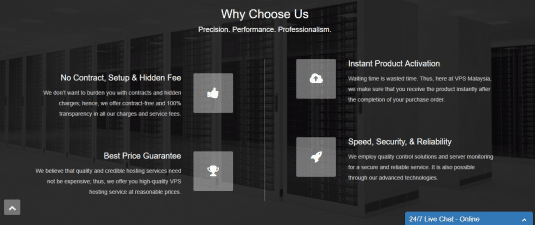
We never oversell our VPS, and we don't need to boast: if you're not convinced, try any plan risk-free. If you're unsatisfied with our service, you can get ALL your money back within 30 days.
Which VPS Hosting Should You Choose?
Choosing reliable VPS hosting comes down to checking the eight factors above before you pay: enough RAM and CPU for your workload, NVMe SSD storage, sufficient bandwidth, a 99.9% uptime guarantee, easy upgrades, a server located close to your visitors, genuine 24/7 support, and a price that reflects stability rather than corner-cutting. Run any provider through that checklist and the marketing noise falls away quickly.
When you are ready, pick the plan family that matches your operating system and workload — every plan is covered by the 30-day money-back guarantee, so there is no risk in trying: